


Personal Wealth Management / Market Analysis
Cheer and Job Market Math
January’s jobs report is a handy sentiment check-in.

It seems to us the latest Employment Situation Report is spurring some odd headlines. Widely heralded as very good news that shows a stabilizing US economy, the report shows nonfarm payrolls jumped by 130,000 in January, trouncing expectations for a milder 75,000 rise.[i] But the big beat stemmed largely from an unforeseen downward revision to last year’s data, and it occurred in a month when statisticians have well-known difficulties with seasonal adjustment. While jobs data are always backward-looking for stocks, the cheerful reaction is another sign US sentiment is running hot relative to the rest of the world—indicating stocks abroad have a bigger wall of worry to climb.
The jobs report actually contained two big revisions. One, previewed last September, was the annual benchmark revision for 2024, a standard practice. Monthly nonfarm payroll data come from a survey that covers about a third of the job market. Survey-based reports, like any data series, have pros and cons. Pro: They are timely. Con: They can be squishy. So every year, the Bureau of Labor Statistics (BLS) battles the squishiness by reconciling its survey-based figures with state-level unemployment claims. The revisions have been extra-big lately due to declining survey response rates and other widely documented issues. But this revision turned out to be not quite as big as initially expected. In September, the BLS estimated the revision would shave -911,000 jobs off the year ending March 2025. The final revision was -898,000.[ii]
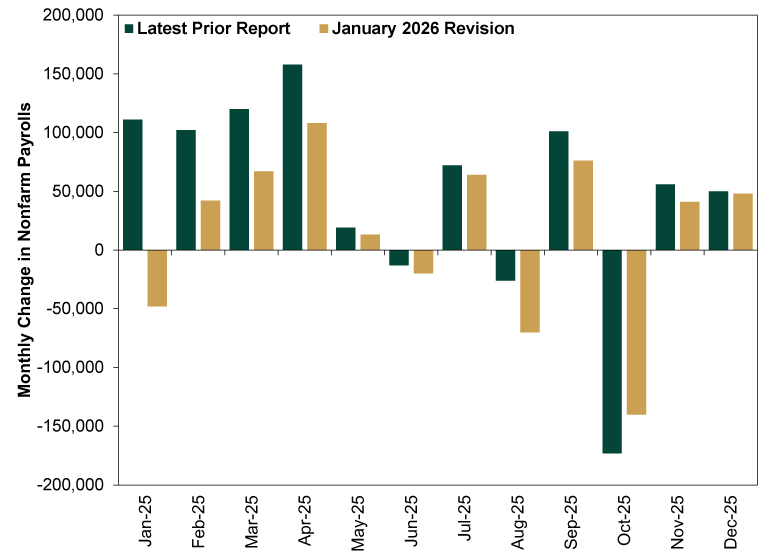
But the second revision bit harder. The BLS has also had trouble with its “birth-death model,” which estimates the number of businesses that form and shut each month. This model aims to account for two flaws in the BLS’s survey-based approach: its inability to add new businesses and the difficulty of determining whether a business that stopped responding to the survey has failed or is just ghosting them. Enter the model, which uses historical data to estimate business formation and failure. And enter the problem of a surge in business creation during the pandemic, which skewed the model. The BLS has now tweaked its methodology in an attempt to rectify these shortcomings, which resulted in big revisions in last year’s monthly data. Exhibit 1 shows the then-and-now.
Exhibit 1: A Year of Data Revisions
Source: BLS, as of 2/11/2026.
The net result: Where earlier reports showed the US adding 577,000 jobs last year, the revisions put the total at just 180,000. This means the base for January job growth is lower than expected, which seems a logical reason for higher-than expected job gains. Add in the seasonal adjustment difficulties as pandemic-related distortions linger in the methodology, and it starts looking like headlines are just really excited about math.
Now, there isn’t anything wrong with optimism. We have long thought the US economy was in better shape than most coverage portrayed it. So it is nice to see some cheer for a change, some recognition that stocks’ economic fundamentals are actually pretty good. It just warrants a raised eyebrow when sentiment looks a little too happy about something. For now it is just an isolated example, but multiply it across the entire economy for a sustained stretch, and it could start looking outlandish. When sentiment runs too hot, it raises the risk of negative surprise hitting stocks.
We aren’t there yet, and it is also worth noting there was some lingering skepticism. While people cheered the small nascent rise in manufacturing jobs, there was another round of angst about healthcare job growth doing most of the heavy lifting. This was a major talking point last year, as if this shows some inherent weakness. But all it really shows is that the US has an aging population, which creates more demand for home health aids and the like, and the US labor market is filling those jobs. It is a well-known, glacial demographic trend gradually showing up in the data. A fact, not a weakness, and nothing that materially moves markets.
Sentiment abroad also counterbalances US optimism, with sentiment toward employment a prime example. Layoffs, higher unemployment rates and automation continue driving labor market gloom across Europe, with employers’ higher tax burden adding extra glumness in the UK. This is emblematic of what looked like too-dreary economic sentiment internationally, which helps keep total global sentiment in check and creates more positive surprise power for non-US stocks.
If you would like to contact the editors responsible for this article, please message MarketMinder directly.
*The content contained in this article represents only the opinions and viewpoints of the Fisher Investments editorial staff.
Get a weekly roundup of our market insights
Sign up for our weekly e-mail newsletter.

You Imagine Your Future. We Help You Get There.
Are you ready to start your journey to a better financial future?

Where Might the Market Go Next?
Confidently tackle the market’s ups and downs with independent research and analysis that tells you where we think stocks are headed—and why.
Related Resources
-
Expert Commentary This Week in Review | Bull Market Birthday, Q3 Earnings, US Inflation
 2026-10-16
 -
Market Analysis Gradually Then Suddenly, UK Budget Clarity Is Coming2026-10-15
-
Market Analysis On September Inflation, Look Beyond the Headlines2026-10-14
-
Politics Is Canada Building a Stronger Bull Market?2026-10-13




Learn More
Learn why 210,000 clients trust us to manage their money and how Fisher Investments and its affiliates may be able to help you achieve your financial goals.
As of 9/30/2026
New to Fisher? Call Us.
Contact Us Today