


Personal Wealth Management / Politics
Market Lessons From Europe’s Political Dramas
Political turbulence hasn’t proven to be a long-term market negative.

Editors’ Note: MarketMinder is politically agnostic. We assess developments for their potential economic and market implications only.
While political bluster in France has calmed somewhat lately, many worry we are only in the eye of a storm—with more turbulence ahead when the 2026 budget’s tax chapter returns to the National Assembly. Many suggest this political instability poses a threat to France’s economy, if not broader Europe. But we have seen similar movies before in Italy and Spain, where “worst-case scenarios” didn’t play out—useful perspective for investors today.
Italy’s Political Opera Is No Tragedy for Markets
Italy has historically been the eurozone’s instability posterchild. Go back nearly eight years, when President Sergio Mattarella dissolved parliament—setting up 2018’s general election.[i] Populist parties were the big winners, with the antiestablishment Five Star Movement (M5S) and euroskeptic the League forming a coalition in June 2018. Many feared the populists would spearhead drastic change (e.g., leave the euro) and preside over a profligate government.
But those concerns overlooked the banal political realities. M5S and the League may both have been outsiders, but they also resided on opposing sides of the political aisle—with an ideological canyon between them. The arrangement collapsed after 14 months when the League left the coalition, replaced by the center-left Democratic Party. This left-leaning government steered Italy through COVID in 2020, but splintered in 2021 over disagreements about pandemic-related aid spending. The premiership of former ECB President Mario Draghi and his technocratic “big tent” coalition followed, lasting around 20 months, before giving way to current Prime Minister Giorgia Meloni.
When Meloni took office, her government was Italy’s fourth in four years—and 68th since the end of World War II.[ii] Some questioned whether the coalition, led by her right-wing Brothers of Italy, would be able to navigate Europe’s energy crisis, hot inflation and high public debt. Three years later, the noise has faded. Meloni has presided over a typical right-leaning government, focused on reducing public spending and cutting taxes. Like anyone else in power, Meloni has encountered pushback. An infrastructure plan to build a €13.5 billion bridge to Sicily has met court resistance.[iii] Opposition parties are dissecting the government’s draft budget, taking issue with proposed tax cuts. But unlike a few years ago, the government looks stable—a rarity in a country that averaged a new cabinet every 13 months.[iv]
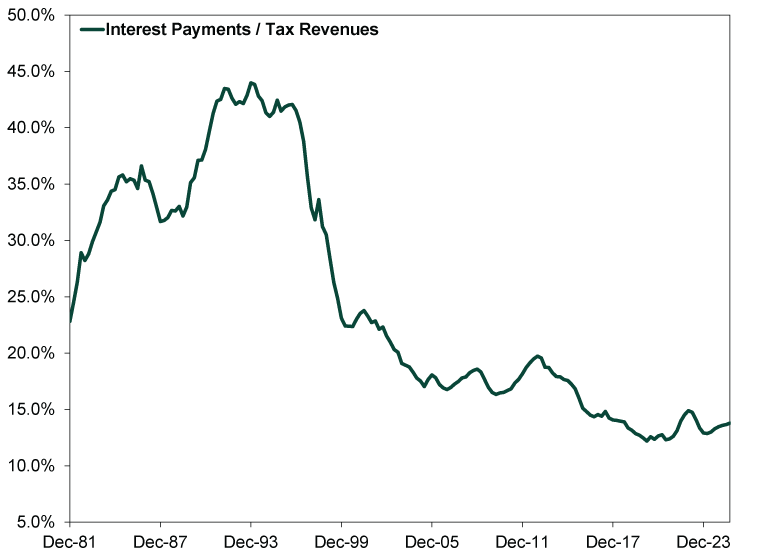
As tumultuous politics faded into the background, Italy’s better-than-feared fundamentals became more apparent to investors. Italian GDP has chugged along, contributing to the region’s growth. Long-running debt sustainability fears have also quieted. Despite carrying a large public debt load, Italy’s interest payments are quite affordable, especially from a historical perspective. (Exhibit 1) Perhaps most telling: Some experts now herald Italy’s success story as an example for the rest of Europe to follow—illustrative of sentiment’s improvement following years of political turmoil.
Exhibit 1: Italy’s Affordable Debt
Source: FactSet, as of 12/3/2025.
Nobody Expected Fast Spanish Expansion!
Italy isn’t Europe’s only example of loud politics overshadowing better-than-appreciated fundamentals. Over in Spain, Prime Minister Pedro Sánchez of the Socialists has presided over a fragile minority government since entering office in 2018. Despite persistent questions about his political future, Sánchez has shown wily survival instincts. He performed some political gymnastics in 2023, using the Socialists’ poor showing in May’s local and regional votes to call a snap general election. Sánchez banked on the opposition failing to form a government—and his gambit proved correct.
To win his current term as PM, Sánchez got the support of Catalan pro-independence parties by agreeing to a controversial amnesty deal for people who faced legal action over holding an illegal Catalan independence referendum. More recently, he has faced corruption allegations—not uncommon in Spanish politics—with thousands of protestors calling for his resignation just last week.[v] The noisy political theater has overshadowed bullish gridlock, as Sánchez’s minority government has struggled to pass major legislation. Spain’s parliament isn’t likely to pass a budget for 2026, which isn’t so weird considering the cabinet has been rolling over its 2023 spending plan (passed in 2022) over the past several years. Yet 2023 government spending levels haven’t required spending reductions for an overlooked positive reason: Strong economic growth has driven tax revenue up.
According to the IMF, Spain was the world’s fastest-growing major developed economy last year, contributing about half of the eurozone’s overall growth.[vi] The country’s bustling services sector has led the way, with tourism, financial services, IT and professional consulting contributing.[vii] The 2022 energy crisis also didn’t knock Spain as hard as other eurozone nations (e.g., Germany) thanks to its lower dependence on Russian energy.[viii] Spain is a reminder national politics are just one driver for investors to consider—and not necessarily the most consequential for the economy or markets.
To be clear, we aren’t painting in broad brushstrokes, as France, Italy and Spain each have unique wrinkles for investors to weigh. But they all show volatile politics aren’t a death knell for markets. Yes, political turbulence can create uncertainty and weigh on stocks in the short term. That may have been the case with France in 2024 after President Emmanuel Macron called a surprise snap election in June. From that announcement through the end of the year, French stocks fell -10.5%, worse than eurozone (-6.6%) and global (7.3%) markets.[ix] But despite the political turbulence continuing this year, French stocks have rebounded, up 25.6% (trailing the MSCI EMU’s 35.6% but leading the MSCI World’s 19.8%).[x]
Taking an even longer view, consider how Italian and Spanish stocks have fared amid years of volatile domestic politics. Since Italy’s populists first gained national power in 2018, Italian stocks are up 131.3%, not far off global stocks’ 138.0% and well ahead of eurozone markets (79.1%).[xi] Similarly, Spain’s political telenovelas haven’t hurt local equity markets: Since Sánchez became PM in June 2018, Spanish stocks have risen 123.9%, a bit behind the MSCI World (134.1%) but also outpacing eurozone markets (78.7%).[xii] Don’t let political turbulence rattle your investment strategy—developments are worth monitoring, but noise alone doesn’t derail stocks. It is just noise.
[i] Interestingly, Mattarella is still Italy’s president.
[ii] “Italy Has Its 68th Government in 76 Years. Why Such a High Turnover?” Andrea Carlo, EuroNews, 10/11/2025.
[iii] “Meloni’s €13.5bn Bridge to Sicily Hits Resistance From Auditors Court,” Amy Kazmin, Financial Times, 10/26/2025.
[iv] See note ii.
[v] “Spain: Thousands of Protestors Call for Sanchez to Resign,” John Silk, AFP, 11/30/2025.
[vi] “Spain’s Shift to Success,” Carlos Cuerpo, International Monetary Fund, June 2025.
[vii] Ibid.
[viii] “After the Energy Crisis: Policy Responses in the Iberian Peninsula,” Gonzalo Escribano, Ana Fontoura Gouveia, João Fachada, and Ignacio Urbasos Arbeloa, Brookings, 7/20/2025.
[ix] Source: FactSet, as of 12/2/2025. MSCI France Index, MSCI EMU Index and MSCI World Index returns with net dividends, 6/9/2024 – 12/31/2025.
[x] Ibid. MSCI France Index, MSCI EMU Index and MSCI World Index returns with net dividends, 12/31/2024 – 12/2/2025.
[xi] Ibid. MSCI Italy Index, MSCI EMU Index and MSCI World Index returns with net dividends, 3/4/2018 – 12/2/2025.
[xii] Ibid. MSCI Spain Index, MSCI EMU Index and MSCI World Index returns with net dividends, 6/2/2018 – 12/2/2025.
If you would like to contact the editors responsible for this article, please message MarketMinder directly.
*The content contained in this article represents only the opinions and viewpoints of the Fisher Investments editorial staff.
Get a weekly roundup of our market insights
Sign up for our weekly e-mail newsletter.

You Imagine Your Future. We Help You Get There.
Are you ready to start your journey to a better financial future?
Where Might the Market Go Next?
Confidently tackle the market’s ups and downs with independent research and analysis that tells you where we think stocks are headed—and why.
Related Resources
-
Expert Commentary This Week in Review | AI Debt, French Bond Yields, Oil Prices
 2026-10-23
 -
Behavioral Finance The Risk in Seeking ‘Safety’2026-10-22
-
In The News October ScamWatch2026-10-21
-
Market Analysis A Mid-October US Economic Scorecard2026-10-20




Learn More
Learn why 210,000 clients trust us to manage their money and how Fisher Investments and its affiliates may be able to help you achieve your financial goals.
As of 9/30/2026
New to Fisher? Call Us.
Contact Us Today