


Personal Wealth Management / Market Analysis
Putting Iran War Worries in Proper Perspective
Headlines feature worries over possible war with Iran, but the market effects are unlikely to be material.

Will the US attack Iran soon? With America shifting forces to the Middle East as nuclear disarmament talks drag, President Donald Trump commented, “So now we may have to take it a step further, or we may not. Maybe we’re going to make a deal. You’re going to be finding out over the next probably 10 days.”[i] Predictably, this is fueling worry about the potential economic and market fallout from a possible strike. But unless conflict escalates far beyond the Middle East, market effects are unlikely to amount to much more than short-term chop—true of most regional conflicts.
Don’t take our word for it: Stocks speak for themselves. Exhibit 1 shows global and Israeli stocks (the only developed market in the Middle East) have barely budged from near-record highs lately. Some may say that could change if and when the shooting starts. But with headlines warning of imminent battle, it isn’t as if markets are unaware—and markets typically pre-price such widely watched events. Indeed, the looming conflict appeared to pique oil prices a bit (less than 2%) Thursday.[ii] But context is key. At $70 a barrel, Brent crude is in the middle of its $60 – $80 range over the last year. Energy prices aren’t spiking. Overall, markets appear to be taking the threat in stride.
Exhibit 1: Regional Conflict Didn’t Stop Stocks
Source: FactSet, as of 2/19/2026. MSCI Israel and World price indexes, 12/31/2024 – 2/19/2026.
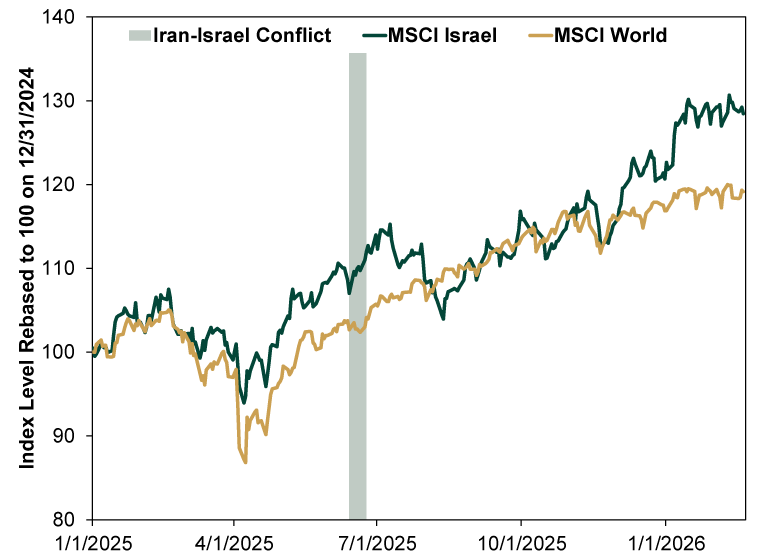
One reason for markets’ apparent calm: They have seen this movie before. Israel attacked Iran in last summer’s 12-day conflict, with the US’s Operation Midnight Hammer assisting in hitting Iranian nuclear facilities—and capabilities. However, it seems that mission wasn’t quite accomplished, which is why talks are ongoing with fear of another conflict rising. Regardless, as Exhibit 1 illustrates, global and Israeli stocks rose during the fighting. We doubt a potential strike would differ materially this time.
While war is always tragic—and causes terrible destruction—stocks coldly look to factors likely to sway earnings or sales over the next 3 to 30 months, and they weigh surprises most. Regional conflicts are generally too small to change the global business or economic outlook dramatically. And broad, leading-the-newscast attention means they are widely anticipated—no surprise. That is why prior conflicts, like 2024’s skirmish between Iran and Israel, hardly rippled. Nor did 2006’s Israel-Hezbollah conflict, the US’s 2003 Iraq invasion, 1990 – 1991’s Desert Storm before that, 1967’s Six-Day War, or, or, or.
Now, some see Russia’s 2022 Ukraine invasion as a counterpoint. But the bear market then was sentiment-driven and stemmed largely from a cornucopia of fears (including lockdown-induced global supply chain disruptions, mistaken monetary policy fueling runaway inflation and rapid about-face rate hikes in response) alongside fear of sanctions and spiking oil prices resulting from the war. Besides, the current global bull market began well before war in Ukraine ended. Both are still ongoing![iii]
What about the Strait of Hormuz? Whenever conflict arises in the Persian Gulf, the prospect of Iran’s blockading the Strait makes headlines. It seems intuitive: The Strait is a chokepoint in a busy waterway carrying as much as a third of seaborne oil shipments daily. But consider a telling counterexample: The Strait of Hormuz never proved a “bottleneck” during the 1980s’ eight-year Iran-Iraq War, even when they were sinking hundreds of each other’s ships and tankers. Only 2% of oil shipments through the Strait were affected then.[iv]
Given the incentive, markets are very adaptable, too. When the Houthis disrupted Red Sea traffic to and from the Suez Canal, freight rerouted from the Horn of Africa around the Cape of Good Hope. Annoying, yes, maybe. But far from disaster. From an economic or market viewpoint, the disturbance barely registered.
Tragically, Middle East conflict is all too common. We have no clue whether we will see yet another outbreak this time. But we see little reason to think this time will prove hugely more problematic to stocks than so many in the past.
[i] “Trump to Decide Whether to Attack Iran in Next 10 Days—Oil Prices Rise,” Spencer Kimball, CNBC, 2/19/2026.
[ii] Source: FactSet, as of 2/19/2026.
[iii] Indeed, parallel Russia-Ukraine talks with America occurred concurrently with US-Iran ones in Geneva this week.
[iv] “Why Iran’s ‘Oil Weapon’ Isn’t That Scary,” Rosemary A. Kelanic, The Washington Post, 6/18/2019.
If you would like to contact the editors responsible for this article, please message MarketMinder directly.
*The content contained in this article represents only the opinions and viewpoints of the Fisher Investments editorial staff.
Get a weekly roundup of our market insights
Sign up for our weekly e-mail newsletter.

You Imagine Your Future. We Help You Get There.
Are you ready to start your journey to a better financial future?

Where Might the Market Go Next?
Confidently tackle the market’s ups and downs with independent research and analysis that tells you where we think stocks are headed—and why.
Related Resources
-
Weekly Wrap-Up Fisher Investments Reviews: Last Week in Markets — October 5 - October 92026-10-12
-
Politics Context for the Noisy Congress to Come2026-10-09
-
Expert Commentary This Week in Review | S&P 500 Record High, Fed Minutes, Spain Election
 2026-10-09
 -
Interesting Market History Notes on a Bear Market Anniversary2026-10-09




Learn More
Learn why 210,000 clients trust us to manage their money and how Fisher Investments and its affiliates may be able to help you achieve your financial goals.
As of 9/30/2026
New to Fisher? Call Us.
Contact Us Today