


Personal Wealth Management / Market Analysis
The Golden Paradox
If gold is a safe haven and inflation hedge, why is it falling hard amid war and inflation fears?

What happens when an asset’s supposed price drivers start conflicting? Take gold. Conventional wisdom deems it a vital safe haven from geopolitical instability. Conventional wisdom also deems it an inflation hedge. Today, we have war in the Middle East driving oil and natural gas prices up, fanning hot inflation fears (which we think remain off base). Yet gold is … down. What gives? Once again, gold is proving itself a volatile commodity that swings on sentiment, not reason.
Late January gave the world a preview of this as gold spiked from $4,611 per troy ounce mid-month to $5,405 on January 29.[i] That, you may recall, was after the Trump administration’s special forces operation in Venezuela, Greenland standoff and threats against Iran during that month’s protests. It looked to us like a speculative frenzy built on fear, and it ended quickly and painfully. Two trading days after its peak, gold was back at $4,715.[ii]
Gold spent February trying to claw its way back up. It eventually got back to $5,314 on March 2, the first trading day after the US and Israel began air strikes on Iran.[iii] That safe-haven move lasted all of one day. Now gold is falling fast, closing Monday at $4,466.[iv] Which means, year to date, gold looks like this:
Exhibit 1: Gold’s Wild Ride
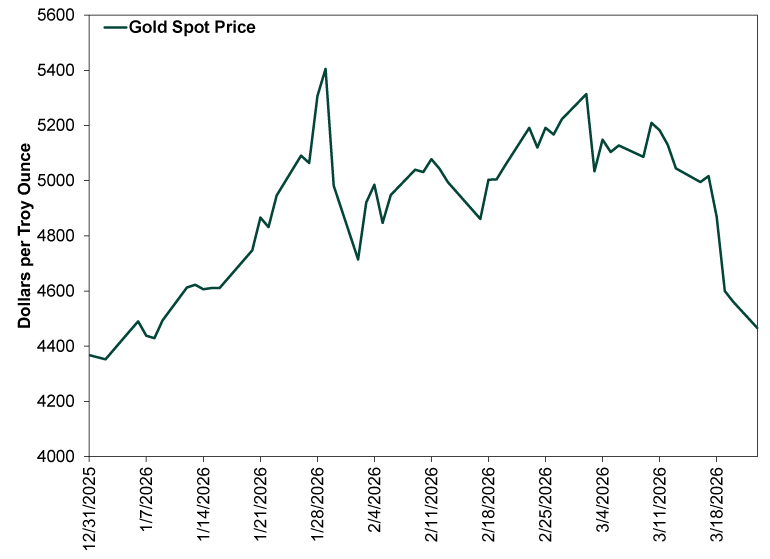
Source: FactSet, as of 3/23/2026. Gold spot price, 12/31/2025 – 3/23/2026.
To us, this makes sense only if you accept that gold moves on sentiment and, like all similarly liquid markets, pre-prices widely expected events. Given the Iran rumors and saber rattling percolated all February, it seems fair to say gold pre-priced conflict fears. We saw some of this in oil, too, with crude starting its rise before the war began.
It would all be simple if the story stopped there. But it didn’t, because inflation fears took over, especially outside the US. This theoretically should have been great for gold, given its mythological inflation hedge powers! But rising inflation expectations fueled rising interest rate expectations. Gold’s lore calls high interest rates bad because gold pays no interest or dividends.
This, friends, is the paradox that lies in gold’s metallic little heart: It is a supposed inflation hedge that also purportedly suffers from inflation’s financial consequences. Inflation cannot be both good for gold and cause high interest rates that are bad for gold. Both of these things cannot hold simultaneously, not at a fundamental level. And if inflation fears and high-rate fears are tugging gold in opposite directions, it is fear doing the heavy lifting. Sentiment. Not fundamentals.
If you think none of this makes a lick of sense, that is kind of our point. Gold’s swings often don’t make sense. That is the nature of sentiment-fueled moves. They can look rational one minute and off in outer space the next. To us, this is a major reason they are impossible to time. As irrational as the human race can be, gold prices take it next level, moving in unconventional ways at weird times and often doing the opposite of what tradition would suggest.
This is why we discourage long-term investors from getting mixed up with gold. We don’t hate gold. It is pretty! But it is a pretty metal with limited physical use, leaving its price prone to speculative whim. Its returns often come in big bursts, with big busts and long fallow stretches in between. We don’t find this a reliable path to the long-term compound growth many folks need to fund retirement goals. Mostly, it lures people with fast moves, tempting folks into the classic error: buying high and selling low.
If you would like to contact the editors responsible for this article, please message MarketMinder directly.
*The content contained in this article represents only the opinions and viewpoints of the Fisher Investments editorial staff.
Get a weekly roundup of our market insights
Sign up for our weekly e-mail newsletter.

You Imagine Your Future. We Help You Get There.
Are you ready to start your journey to a better financial future?
Where Might the Market Go Next?
Confidently tackle the market’s ups and downs with independent research and analysis that tells you where we think stocks are headed—and why.
Related Resources
-
Weekly Wrap-Up Fisher Investments Reviews: Last Week in Markets — October 5 - October 92026-10-12
-
Politics Context for the Noisy Congress to Come2026-10-09
-
Expert Commentary This Week in Review | S&P 500 Record High, Fed Minutes, Spain Election
 2026-10-09
 -
Interesting Market History Notes on a Bear Market Anniversary2026-10-09




Learn More
Learn why 210,000 clients trust us to manage their money and how Fisher Investments and its affiliates may be able to help you achieve your financial goals.
As of 9/30/2026
New to Fisher? Call Us.
Contact Us Today