


Personal Wealth Management /
Store of Value: What It Means and Why It’s a Fallacy
Explore this Article:
- What Does “Store of Value” Mean?
- There’s No Such Thing as a True Store of Value
- Examining Gold as a “Store of Value”
- “Store of Value” vs. Inflation Protection
- Assets Often Thought of as Stores of Value
- What To Focus on Instead of “Stable Value”
- How To Grow Value Instead of Storing It
- Store of Value FAQs
In times of economic uncertainty, the term “store of value” often resurfaces as investors search for assets they believe will protect them from loss. But while the term is widely used, especially in discussions about gold, precious metals or digital currency, it often promises more certainty than markets can deliver.
Over long periods, simply trying to "maintain" value is often a losing battle. Protecting your long-term purchasing power typically requires growth, not stasis. To understand why, one must look past the marketing and examine the logic behind how value is actually preserved, or lost, in a modern economy.
What Does “Store of Value” Mean?
A store of value refers to an asset that is expected to maintain purchasing power so it can be exchanged in the future for the same amount of goods or services. Historically, this value function has been associated with items like coins, precious metals or other tangible assets.
But this expectation is not guaranteed. Calling something a store of value does not ensure it will perform that role consistently. Value is always measured relative to something else. It depends on what the asset can be exchanged for, when the exchange occurs and whether there is demand at that moment.
In practice, assets rarely maintain a stable relative purchasing power over extended periods of time.
There’s No Such Thing as a True Store of Value
The reason no single asset can perfectly fulfill the store of value promise is simple: supply and demand dynamics never stop operating. The price of any asset, whether it is a precious metal, a digital currency or a piece of real estate, is determined by what a buyer is willing to pay and what a seller is willing to accept at a specific moment in time.
If an asset’s price can fluctuate, it can fail at "preservation." Investors often seek out assets with a limited supply, believing that scarcity equates to a reliable future value. But supply is only half of the equation. Demand is fickle and can be driven by sentiment, utility, the availability of alternatives or any number of other factors. If demand for a "store" drops, the value drops with it, regardless of how "scarce" the item is.
Furthermore, there is a fundamental risk-reward tradeoff that cannot be bypassed. In order for an asset to be a stable store of value, almost by definition this means it has low growth potential. Conversely, if an asset has the potential to grow significantly, it must, by definition, be capable of significant decline. You cannot have the upside of a market-driven asset without the risk of corresponding downside volatility.
Expecting an asset to "freeze" its value in a dynamic global economy is, in many ways, an attempt to opt out of the market entirely. It is a feat that is rarely possible without sacrificing the very growth needed to outpace inflation.
Examining Gold as a “Store of Value”
Gold is perhaps the most famous example of a purported store of value. For centuries, it has been viewed as "real" money because it’s tangible and globally recognized as a precious metal.
That reputation helps explain why gold tends to resonate emotionally during periods of economic stress. It feels permanent, detached from political systems and immune to central bank decisions. But its history paints a more complicated picture.
Gold price movements are driven by supply and demand, not by any built-in mechanism that preserves value. There have been long stretches where gold failed to keep pace with inflation or declined in real terms. There have also been periods when it performed well. The results are inconsistent. For example, as shown in the chart below, while gold has beaten inflation and risen over 3,000% since it first started freely trading in the US in 1974, those results have been dwarfed by the returns of the S&P 500—with long stretches of flat returns along the way.
Exhibit 1: S&P 500 Total Return vs. Gold
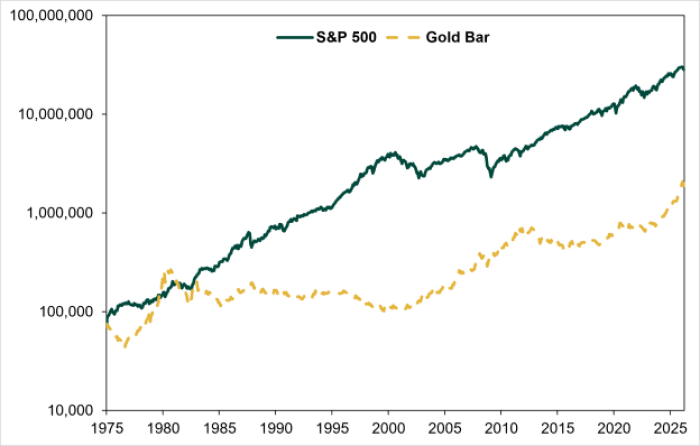
Exhibit 1 Long Description
This is a chart with two lines showing the growth by percent of gold and the S&P 500 since 1975. It shows that apart from a brief period in the early 1980s the S&P 500 index would have provided stronger performance.
Source: Finaeon, as of 4/13/2026. S&P 500 total return and gold price per troy ounce, 12/31/1974 – 3/31/2026. Y-axis in base-10 logarithmic scale, which plots the same-sized percentage moves in equal increments graphically.
Gold supply is not fixed either. When prices rise, production responds over time. Global output has fluctuated meaningfully over recent years, illustrating that limited supply does not mean static supply.
Gold also produces no income. Unlike interest-bearing assets or businesses that can adapt to a changing modern economy, gold remains what it is. Its value depends entirely on what someone else is willing to pay for it at a given moment. That makes gold a commodity, not a reliable store of value. Its reputation endures largely because of narrative and memory, not because it consistently preserves purchasing power.
Check Your Retirement Readiness.
Request an Appointment
“Store of Value” vs. Inflation Protection
A common mistake many investors make is using "store of value" and "inflation protection" interchangeably. While they are related, they are not the same thing. Inflation protection is an outcome—the result of an investment's total return exceeding the rate of rising prices. A store of value is a label often applied to assets that people hope will provide that protection.
Inflation protection is never automatic. Even assets that are traditionally linked to inflation, like certain commodities, do not always move in lockstep with the Consumer Price Index (CPI). The CPI is also a general measure of inflation across the economy and may not represent what you individually experience based on your spending. High or low inflation does not guarantee strong performance from any specific asset class.
For instance, during the high-inflation era of the 1970s, gold performed well. However, in other periods of rising prices, such as 2022 when inflation spiked to 9.1% year over year, it failed to keep up. True protection against the erosion of wealth requires an asset that can grow its earnings or its underlying value at least at the same rate or faster than the local currency is devaluing. Labeling an asset a "good store" does not make it so; only its performance relative to the cost of goods and services over time can determine its effectiveness.
Assets Often Thought of as Stores of Value
A wide range of assets are marketed as good candidates to store value. Each comes with limitations that often get overlooked:
Gold and Other Precious Metals
Gold and silver are frequently promoted as reliable store options, but as we discussed, both are commodities whose prices fluctuate based on demand, exchange dynamics and expectations. They offer no cash flow and can lag inflation or the growth rate of other assets for extended periods.
Standard Treasury Bonds
Treasury bonds are sometimes viewed as safe because they are backed by the United States government. But their value fluctuates with interest rates and inflation. As bonds mature, reinvestment risk emerges. They are not inherently inflation-adjusted unless you select Treasury Inflation-Protected Securities (TIPS).
Real Estate
Homes and property are tangible assets that contribute to net worth and wealth. But real estate values depend heavily on location, timing, financing costs and demand. Homes also carry maintenance and insurance costs and are not always liquid. While they can be a fulfilling personal investment, they are not automatically a reliable store of value.
Digital Assets and Cryptocurrencies
Some proponents describe bitcoin and other crypto assets as digital gold or an alternative store of value. These digital assets have a short history, extreme volatility and unique risks. Custody, exchange failures and security issues add additional layers of uncertainty. Their role as money or a stable store remains unproven.
In every case, value depends on demand at the moment of exchange. No asset escapes that reality.
Check Your Retirement Readiness.
Request an Appointment
What To Focus on Instead of “Stable Value”
If the quest for a perfect store of value is a dead end, what should an investor do? At Fisher Investments, we believe the focus should shift from trying to "freeze" value to actively growing it.
Long-term purchasing power is built through a combination of growth, diversification and time. For most investors, the goal isn't just to have the same amount of money in 20 years; it's to be able to afford the same, or better, standard of living. This requires an orientation toward assets that have the capacity to appreciate and the liquidity to generate income when needed.
Volatility is often viewed as a "failure" of an asset to store value. But in reality, volatility is simply the cost of admission for long-term growth. Equities, for example, are shares of businesses that can innovate by adjusting prices in response to market forces and finding new ways to grow their profits. While their prices fluctuate daily, diversified equity portfolios have historically tended to keep up with or even outpace inflation.[i]
Diversification is another key tool. Rather than searching for one "perfect" asset to protect your wealth, spreading your capital across different sectors, countries and asset classes addresses risk far more effectively. If you are focused on near-term income, those funds should not be forced into speculative "store of value" roles; they should be managed with a focus on liquidity and growth, acknowledging the trade-offs involved.
Ultimately, the most reliable way to maintain your purchasing power in a modern economy is to develop a portfolio strategy with assets whose growth potential is in line with your goals, stay diversified in case you are wrong and remain disciplined.
How To Grow Value Instead of Storing It
The idea of a store of value is appealing because it suggests certainty in an uncertain world. But markets do not offer certainty. Value is not stored automatically. It is constantly reassessed through exchange.
Assets that promise stability often deliver variability, while assets that deliver growth naturally come with risk. Understanding that tradeoff is more useful than searching for a perfect store of value. But translating that understanding into a long-term strategy that reflects your goals, time horizon and risk tolerance requires a broader perspective.
Fisher Investments serves individual investors and institutions around the world as a fiduciary investment adviser. We focus on long-term growth, diversification and disciplined decision-making rather than reacting to short-term market narratives.
If you’d like to discuss how these principles may apply to your own situation, request an appointment with a Fisher Investments representative to learn more about our approach.
Store of Value FAQs
Is Gold a Store of Value?
Historically, no asset, including gold, has consistently preserved purchasing power across all environments. Gold, despite periods of rapid appreciation, has also experienced long periods of underperformance relative to inflation.
Is Bitcoin a Store of Value?
Bitcoin is often described as digital gold, but it has a short performance history, high volatility and significant risks. Its behavior as a store of value remains uncertain.
Are Treasury Bonds a Store of Value?
Treasury bonds can reduce certain risks, but they are sensitive to interest rates and inflation. Their ability to preserve real value depends on timing and reinvestment conditions. Even supposedly inflation-protected TIPS may not align with the inflation rate that an individual investor experiences.
What Is the Takeaway for Investors?
Focusing solely on maintaining value can be misleading. Long-term purchasing power is influenced by growth, diversification and time. Labels like “store of value” often obscure the tradeoffs involved.
[i] Source: Bureau of Labor Statistics and FactSet, as of 2/10/2026. US Consumer Price Index, 1/1/1925 – 12/31/2025. S&P 500 Total Returns Index, 1/1/1925 – 12/31/2025.
This article is for informational and educational purposes only and should not be construed as investment advice or a recommendation regarding any particular investment strategy or course of action. The information presented is general in nature and does not take into account the individual circumstances, objectives, or financial situation of any specific investor. We provide our general comments to you based on information we believe to be reliable. There can be no assurances that we will continue to hold this view; and we may change our views at any time based on new information, analysis or reconsideration. Some of the information we have produced for you may have been obtained from a third-party source that is not affiliated with Fisher Investments.
Fisher Investments has no duty or obligation to update the information contained herein.

You Imagine Your Future. We Help You Get There.
Are you ready to start your journey to a better financial future?

When to Retire: A Quick and Easy Planning Guide
No matter your age or where you are in your career, the time to think about your retirement is now.
Insights & Media
-
Expert Commentary This Week in Review | Bull Market Birthday, Q3 Earnings, US Inflation
 2026-10-16
 -
Market Analysis Gradually Then Suddenly, UK Budget Clarity Is Coming2026-10-15
-
Market Analysis On September Inflation, Look Beyond the Headlines2026-10-14
-
Politics Is Canada Building a Stronger Bull Market?2026-10-13




Learn More
Learn why 210,000 clients trust us to manage their money and how Fisher Investments and its affiliates may be able to help you achieve your financial goals.
As of 9/30/2026
New to Fisher? Call Us.
Contact Us Today